
- By shoulderadm
- In Blog
Common types of Shoulder Surgery
Most often, it is due to the tendencies of people to wait and watch on the shoulder problem that finally leads them to the option of surgery. They either wait with the hope that the injury/problem would heal on its own, or due to lack of time or for some other reason. Orthopaedic/Shoulder surgeons often recommend non-surgical standard methods of treatment as the first step. It is only when these non-surgical options do not help in relieving the symptoms, surgery is opted as an option for certain cases.
We will now try to understand the common types of shoulder surgeries. Some of the surgeries explained below are arthroscopic procedures (Key Hole Surgeries) while others are standard open surgeries.
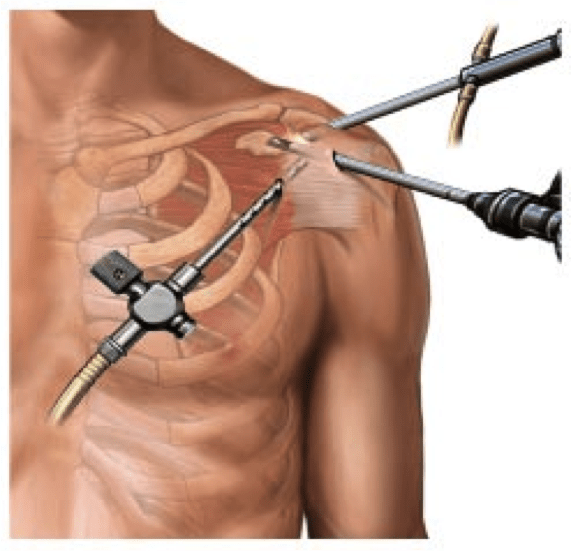
Subacromial Decompression/Acromioplasty
Subacromial Decompression/Acromioplasty is a shoulder surgery performed to treat a condition called Shoulder Impingement. In subacromial impingement the space between the shoulder blade and rotator cuff tendons get reduced, thus creating inflammation in that region. In this space are the rotator cuff tendons and the bursa (fluid-filled sacs that helps to reduce friction in the shoulder spaces). Acromion is a bony process on the scapula (shoulder blade) and space underneath is where impingement occurs, hence the name subacromial impingement. The aim of the procedure is to open up the tight space so that the rotator cuff can glide smoothly.
Rotator Cuff Repairs
The rotator cuff is a group of muscles and tendons that are present in the shoulder joint and help to hold the arm in its joint and help the shoulder joint to move. Rotator Cuff Repair is a surgery performed to repair the torn tendon in the shoulder. The procedure often involves re-attaching the tendon to the head of the humerus (upper arm bone). It is one of the most common surgeries for the shoulder. Rotator Cuff Repairs can be done by open surgical method or it can be done arthroscopically depending on the case. If not treated properly the rotator cuff disorders may get worse. The pain can increase over time and you may lose range of motion and strength in your shoulder.
SLAP Repair Surgery
The term SLAP stands for Superior Labrum Anterior to Posterior. The Labrum is the ring of cartilage that surrounds the socket of the shoulder In a SLAP tear, the top portion of the labrum is injured. This top portion is the location of the attachment of the long head of the biceps tendon. A SLAP tear occurs both in front and back of this attachment point.
Many cases of SLAP tear are treated using Physiotherapy and anti-inflammatory and pain medications. In patients who have continued symptoms in spite of these treatments, surgery might be recommended. A SLAP repair is a minimally invasive arthroscopic procedure which uses a tiny camera and miniature surgical instruments to repair the damaged area. Laparoscopic surgery is performed with the aim to repair the torn labrum back to the rim of the shoulder socket. At times, SLAP tears occur along with other shoulder problems such as rotator cuff tears and shoulder arthritis. In such cases, surgery will take into account these factors.
Bankart Repair for Unstable Dislocating Shoulders
Bankart repair can be done as an open surgery or a keyhole surgery. Of late, most of these surgeries are done arthroscopically. It is done to repair instability and restore function of dislocated shoulders. Shoulder dislocations can tear the glenoid labrum and ligaments that helps provide stability to the shoulder. The aim of Bankart repair surgery is to re-attach the torn labrum and ligaments back to the tip of the glenoid. If a Bankart tear doesn’t heal properly, it can cause future dislocations, instability, weakness and pain.
Total Shoulder Replacements
Total shoulder replacement, is also known as total shoulder arthroplast. Shoulder Replacement Surgeries are usually recommended for some complex conditions when other non-surgical treatment options fail to relieve the symptoms.
In this procedure, the damaged humeral head (ball) is replaced with a metal ball and the socket is covered with a new plastic surface. Some of the risks of surgery of shoulder replacement include infection, wound healing problems, bleeding and injury to nerves and vessels near the fracture. Following are the few common conditions that may require a total shoulder replacement surgery:
- Osteoarthritis
- Post-traumatic arthritis
- Rheumatoid arthritis
- Osteonecrosis
- Severe fractures
Capsular Release Surgery
Capsular Release is an arthroscopic surgery performed with the aim to release the tightness found in the capsule in cases of Frozen Shoulder. Frozen shoulder is a painful condition in which the shoulder becomes ‘stuck’. It often starts for no reason, but may be triggered by a mild injury to the shoulder.
Traditionally, frozen shoulders were treated using Manipulation under Anaesthesia (MUA) where surgeons used to move the shoulder through a range of motions which causes the capsule and scar tissue to stretch and tear. It is still very effective procedure in cases of simple frozen shoulders.
In Capsular Release surgery, the thickened swollen capsule tissue is cut and removed. Post-surgery, immediate rehabilitation is provided.
Surgery for Acromioclavicular (AC) Joint Separation
An Acromioclavicular joint separation is an injury to the ligament that holds the AC joint together at the top of the shoulder. The AC joint is where the clavicle (collarbone) meets the top of the acromion (shoulder blade). Surgery for an AC joint injury aims to relieve pain and restore function by removing the damaged end of the clavicle bone.
AC joint sprains ranges from very mild (Grade 1) to very severe (Grade 6) injury. Grade 1, 2 and 3 injuries are usually treated with conservative non-surgical methods. Grade 4,5 and 6 injuries usually require surgery. There are certain exceptions depending on the case where sometimes a Grade 3 injury might need a surgery and a Grade 4 injury might get treated using non-surgical methods. Acromioclavicular (AC) joint injuries are most common among male sportsmen under 30 years of age, and account for 3 – 12% of the shoulder injuries seen by orthopedic surgeons
Surgery for Biceps Tendonitis
Bicep muscles has two tendons – one attaches the muscle to the bone of the shoulder and the other attaches to the radius bone at the elbow. Biceps tendonitis, also called bicipital tendonitis or is inflammation in the main tendon which attaches top of biceps muscles to the shoulder.
Most of the patients respond well to the conservative treatments. Surgery is usually recommended when non-surgical treatment options does not help relieve the symptoms or when there are other shoulder problems present. The most common surgery for biceps tendonitis is acromioplasty. Another surgery is Biceps tenodesis, which is a method of reattaching the top of biceps tendon to a new location. This procedure is typically used when the biceps tendon causes pain in and around the shoulder.These kinds of injuries are most common in young athletes, such as swimmers, gymnasts, and those involved in throwing or contact sports.This surgery is performed only in cases where biceps tendon is severely degenerated or when shoulder reconstruction for other problems is needed.
Repair of Shoulder Fractures
A fracture is the medical term for a broken bone. Shoulder fractures involve at least one of the three bones – the scapula (shoulder blade), clavicle (collarbone) or humerus (upper arm bone). The most common fracture is a fractured humerus.
Fractures are either described as being displaced or non-displaced. Nearly 80 percent of all shoulder fractures are non-displaced. This implies that the broken pieces remain near their anatomic position and treatment merely requires immobilization in a sling until the bone fragments heal. Surgery is needed when there is injury to the glenoid or when fractured fragments are displaced. If the ball portion of the upper arm is fractured or crushed, a shoulder replacement might be required.
Post – Operative Recovery
Even though there is minimal invasion using an arthroscope in a shoulder surgery, there is usually an extensive recovery period which can last for up to six months. The reason for this is that it takes some time for the tendon to heal and to re-attach properly to the bone. The first phase of recovery can potentially last up to 6 weeks after the surgery. You will be instructed to keep the shoulder as immobile as possible and to keep your arm in a post-operative sling. The use of the sling keeps the weight of your arm off of the tendon which assists in the healing process.
The recovery period and the subsequent pain will vary from person to person and depend on the extent of the repair to the shoulder. The frequent application of cold packs to the area will help to reduce the swelling and the pain. From 3 to 6 months after the shoulder surgery muscle strengthening exercises will be advised because of the relatively long period of inactivity. Some tips for a speedy recovery include wearing a sling, Sleep carefully in a reclined position, watching out for complications, doing physical therapy, pacing and being mindful about all your movements.
For questions related to shoulder surgery, and rehabilitation, write to www.BangaloreShoulderInstitute.com/contact or call 9846789204


